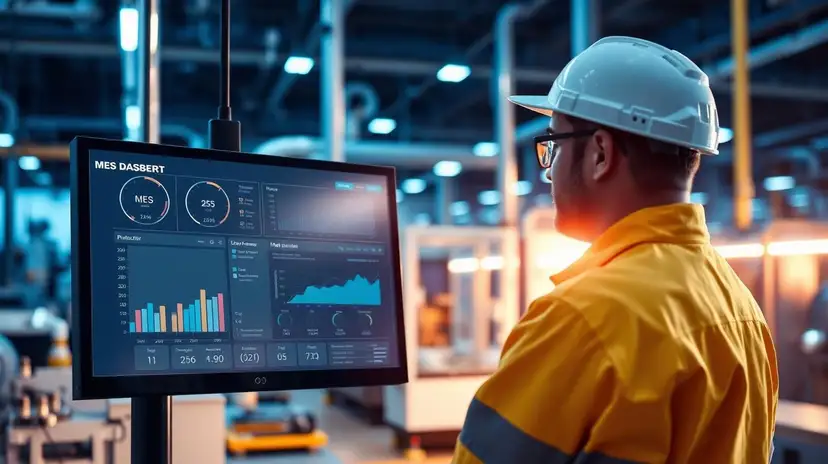
The term Manufacturing Execution System — or MES — comes up often in Industry 4.0 conversations, but many manufacturing leaders struggle to pin it down precisely. "Is it like an ERP?". "A monitoring system?". "Line supervision?".
Short answer: it's the layer that connects planning (the ERP) to physical execution (the machines). And in many Italian plants today, it's simply absent.
Operational definition
A MES — like our Badil MES — does four main things:
- Receives production orders from the ERP and translates them into work orders for the lines.
- Collects production data in real time: what was produced, by whom, in how long, with how much waste.
- Computes efficiency KPIs (OEE, setup times, downtime) automatically — no manual forms.
- Returns finalized data to the ERP at production close, closing the loop.
In practice, it's the system that lets HQ know in real time what's happening on the floor — and gives the floor clear, up-to-date instructions.
Three signals you need one
1. You don't know your line OEE precisely
If OEE is calculated end-of-month in Excel from forms filled by operators, you have a data reliability problem. The number exists, but it's weeks late and probably underestimates micro-stops. A MES measures real-time, from the machine.
2. Lot traceability takes too long
If answering "which lot received raw material X that arrived on day Y" requires manual interviews and searches, you lose days and risk errors. A MES tracks every material movement automatically.
3. Planning is disconnected from execution
If the production office writes the plan Sunday night and by Monday morning reality is already different — a machine is down, a material didn't arrive, an operator is absent — and nobody can replan quickly, you have a sync problem a MES solves natively.
When you DON'T need a MES
For intellectual honesty, not every manufacturer needs a MES.
- Highly custom unit/order production: better tracked as job orders in the ERP.
- Workshops with few machines (under 5 lines) and very experienced operators: marginal ROI.
- Production with no traceability or yield constraints: spend better elsewhere (e.g. planning).
Realistic cost
For a mid-sized Italian plant (10-30 lines, 50-200 operators), a real MES — not a notepad called a MES — costs between €40k and €150k setup, plus an annual management fee. The range depends on line count, integration with existing machines (PLCs), and process complexity.
Average payback we see on customers where the MES was really "the missing piece" is 18-24 months, primarily from: fewer unplanned stops (-25 to -40%), less waste (-15 to -30%), shorter setup times (-10 to -20%).
Frequently asked questions
1What's the difference between MES and ERP?
ERP plans orders, materials and costs at the head-office level. MES executes that plan on the shop floor: it receives production orders, collects real-time data from lines, calculates OEE and sends actuals back to ERP. They are complementary, not alternatives.
2When does a manufacturer really need a MES?
When you don't know real line OEE, batch traceability is manual, or planning is disconnected from execution. Those are the three main signals that MES is the missing piece.
3How much does a MES implementation cost in Italy?
For a mid-sized plant (10-30 lines, 50-200 operators) setup ranges from 40k to 150k euros plus annual fee. Typical payback is 18-24 months from reduced downtime (-25-40%), scrap (-15-30%) and setup times (-10-20%).
4Does a MES integrate with existing machines?
Yes, via PLCs and standard industrial protocols (OPC UA, MQTT). Older machines may require dedicated gateways, but integration is almost always feasible without replacing the plant.
Want to know if you're ready for a MES? We do assessments.
Request assessment